YOUR GENERAL SURGERY OUTCOMES, IN ONE CLEAR RECORD

Capture your cases and complications as you operate, find out what happened after your patients went home, and see how your results compare_

Capture your cases and complications as you operate, find out what happened after your patients went home, and see how your results compare_

The outcomes that define your elective list mostly appear after the patient has gone home.

A wound infection that presents to a GP in week two. Chronic groin pain eighteen months after a hernia repair. A patient who never comes back because everything settled, and another who never comes back because they went somewhere else.

The majority of surgical site infections present after discharge, and chronic pain after inguinal hernia repair is considerably more common than most surgeons’ recollection of it. None of that reaches you unless something asks.

Which leaves the questions you cannot answer from memory:

How many of my patients developed a wound infection after discharge?

What is my hernia recurrence rate, really?

Could I produce a benchmarked audit of my elective work this week?

The outcomes that define your elective list mostly appear after the patient has gone home.

A wound infection that presents to a GP in week two. Chronic groin pain eighteen months after a hernia repair. A patient who never comes back because everything settled, and another who never comes back because they went somewhere else.

The majority of surgical site infections present after discharge, and chronic pain after inguinal hernia repair is considerably more common than most surgeons’ recollection of it. None of that reaches you unless something asks.

Which leaves the questions you cannot answer from memory:

How many of my patients developed a wound infection after discharge?

What is my hernia recurrence rate, really?

Could I produce a benchmarked audit of my elective work this week?

The outcomes that define your elective list mostly appear after the patient has gone home.

A wound infection that presents to a GP in week two. Chronic groin pain eighteen months after a hernia repair. A patient who never comes back because everything settled, and another who never comes back because they went somewhere else.

The majority of surgical site infections present after discharge, and chronic pain after inguinal hernia repair is considerably more common than most surgeons’ recollection of it. None of that reaches you unless something asks.

Which leaves the questions you cannot answer from memory:

How many of my patients developed a wound infection after discharge?

What is my hernia recurrence rate, really?

Could I produce a benchmarked audit of my elective work this week?

WHAT ALREADY GETS MEASURED

WHAT ALREADY GETS MEASURED

In general surgery, the only mandatory audit is of deaths.

Your data in real time.

Participation in the surgical mortality audit is compulsory and it does important work. But its scope is deaths in hospital associated with surgical care.

The cholecystectomies, hernias, appendicectomies and anti-reflux procedures that make up the bulk of an elective list are not benchmarked for you anywhere, and there is no national hernia registry in Australia or New Zealand. For the work you do most, the only audit is the one you build yourself.

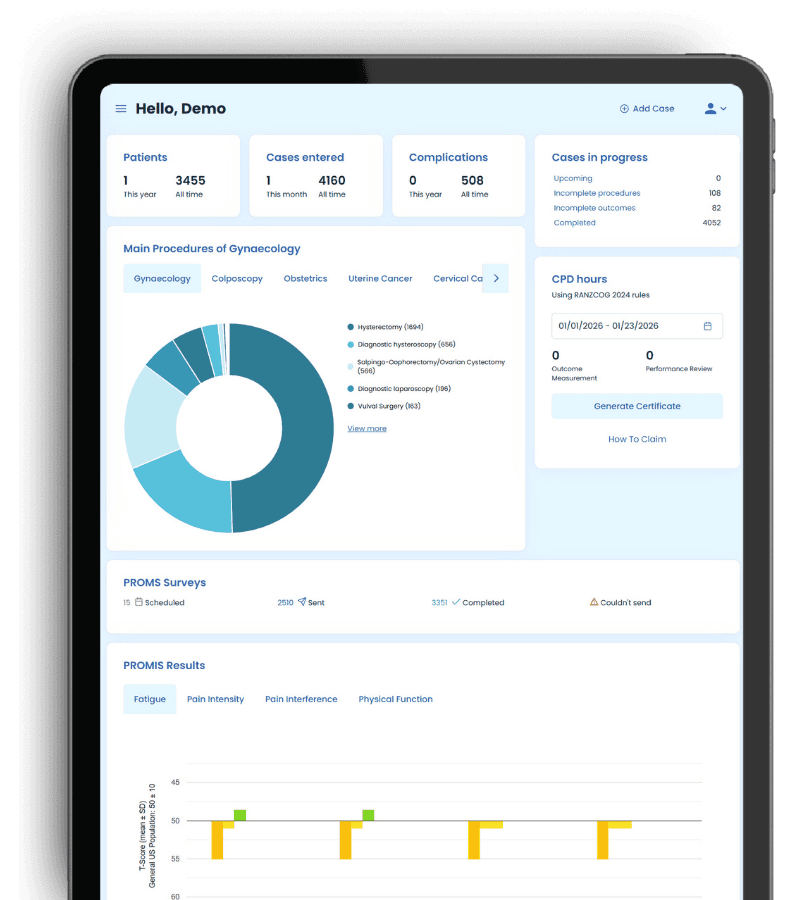
An image if the Surgical performance Dashboard

INSIDE THE GENERAL SURGERY MODULE

Built around the procedures and outcomes that define general surgery

Built around the procedures and outcomes that define general surgery

From hernia and gallbladder work to upper GI, capture the activity and outcomes across a broad and busy list.

From hernia and gallbladder work to upper GI, capture the activity and outcomes across a broad and busy list.

Your full case mix
Better Visibility

Hernia, cholecystectomy, appendicectomy, upper GI and anti-reflux procedures, and the rest of your elective and emergency work.

Hernia, cholecystectomy, appendicectomy, upper GI and anti-reflux procedures, and the rest of your elective and emergency work.

The complications that matter

Surgical site infection, bile duct injury, return to theatre, readmission and reoperation, recorded as they happen.

Functional recovery
Powerful Audit-Ready Data

Recovery, pain and function reported by your patients in the weeks and months after they leave your care.

Personal trends over time
Surgeon-Led Improvement

Patterns across procedures and across years that no single case can show you.

Patterns across procedures and across years that no single case can show you.

Audit-ready whenever
Surgeon-Led Improvement

A total practice audit produced as a by-product of how you already work.

A total practice audit produced as a by-product of how you already work.

 Your data is yours. It is not shared with your hospital, your college or your insurer, and it does not appear in any public rating.

Only de-identified, aggregated data powers peer benchmarks.

THE PATIENT’S VIEW

Find out what actually happened after they left

PROMS sends validated surveys to your patients by SMS at intervals appropriate to the procedure, and you choose which go out when you set up each case.

For abdominal and inguinal hernia repair, the Abdominal Hernia Questionnaire runs from a pre-operative baseline out to 6, 12 and 18 months, which is the window where recurrence and chronic pain actually declare themselves.

Alongside it, the PROMIS Recovery from Surgery survey covers pain, fatigue and physical recovery at two weeks, six weeks and six months across the rest of your list. You can also receive clear insights to protect your reputation via the Patient Satisfaction survey, and validated surveys continue to be added to the PROMS library.

THE PATIENT’S VIEW

Find out what actually happened after they left

PROMS sends validated surveys to your patients by SMS at intervals appropriate to the procedure, and you choose which go out when you set up each case.

For abdominal and inguinal hernia repair, the Abdominal Hernia Questionnaire runs from a pre-operative baseline out to 6, 12 and 18 months, which is the window where recurrence and chronic pain actually declare themselves.

Alongside it, the PROMIS Recovery from Surgery survey covers pain, fatigue and physical recovery at two weeks, six weeks and six months across the rest of your list. You can also receive clear insights to protect your reputation via the Patient Satisfaction survey, and validated surveys continue to be added to the PROMS library.

THE PATIENT’S VIEW

Find out what actually happened after they left

PROMS sends validated surveys to your patients by SMS at intervals appropriate to the procedure, and you choose which go out when you set up each case.

For abdominal and inguinal hernia repair, the Abdominal Hernia Questionnaire runs from a pre-operative baseline out to 6, 12 and 18 months, which is the window where recurrence and chronic pain actually declare themselves.

Alongside it, the PROMIS Recovery from Surgery survey covers pain, fatigue and physical recovery at two weeks, six weeks and six months across the rest of your list. You can also receive clear insights to protect your reputation via the Patient Satisfaction survey, and validated surveys continue to be added to the PROMS library.

Portrait of doctor in scrubs smiling

START NOW

See your general surgery outcomes clearly, from your very first case

Portrait of doctor in scrubs smiling

START NOW

See your general surgery outcomes clearly, from your very first case

LOW-ADMIN BY DESIGN

Built for a full theatre list and a busy clinic

Start capturing surgical insights — in minutes.

Step 01

Start a case in seconds

Quick Case lets you or your rooms open a case and schedule its surveys in seconds. Record as much detail as you prefer.

Step 02

Follow-up runs itself

Surveys run automatically, and responses come back to you, privately.

Step 03

Review in a minute

Scan the recovery of everyone you operated on last week, and the weeks before, in under a minute.

Step 04

Reflect and act

Use what you see for your CPD, for conversations with colleagues and referrers, and for your own practice.

THE RECORD COMPOUNDS

The record you build is yours, and it gets more valuable every year.

A general surgeon who starts this year has a decade of their own elective outcome data in ten years’ time. One who waits five years does not.

It is also the difference between saying you audit your practice and being able to show it, with a record that follows you rather than the hospital.

THE RECORD COMPOUNDS

The record you build is yours, and it gets more valuable every year.

• Outcome tracking and performance review
• Patient satisfaction and feedback
• Quality improvement activities
• Reflective practice and benchmarking

THE RECORD COMPOUNDS

The record you build is yours, and it gets more valuable every year.

A general surgeon who starts this year has a decade of their own elective outcome data in ten years’ time. One who waits five years does not.

It is also the difference between saying you audit your practice and being able to show it, with a record that follows you rather than the hospital.

Your annual surgical audit, without the year-end scramble

Surgeons are expected to participate in a surgical audit each year and submit it for peer review, benchmarked against a standard or against peers. A total practice audit and a selected audit from surgical practice are both accepted formats. Every case you enter builds toward it, so the audit becomes a by-product of how you already work rather than a separate exercise in December.

CERTIFIED LEARNING PROVIDER WITH AMA CPD HOME

• Outcome tracking and performance review
• Patient satisfaction and feedback
• Quality improvement activities
• Reflective practice and benchmarking

RANZCOG Logo

Your annual surgical audit, without the year-end scramble

Surgeons are expected to participate in a surgical audit each year and submit it for peer review, benchmarked against a standard or against peers. A total practice audit and a selected audit from surgical practice are both accepted formats. Every case you enter builds toward it, so the audit becomes a by-product of how you already work rather than a separate exercise in December.

CERTIFIED LEARNING PROVIDER WITH AMA CPD HOME

RANZCOG members can also claim 5 CPD hours annually across Performance Review and Outcome Measurement categories upon
completing 30 cases within SurgicalPerformance.

RANZCOG Logo

SUPPORTS CPD ACROSS
MULTIPLE COLLEGES

Surgeons are expected to participate in a surgical audit each year and submit it for peer review, benchmarked against a standard or against peers. A total practice audit and a selected audit from surgical practice are both accepted formats. Every case you enter builds toward it, so the audit becomes a by-product of how you already work rather than a separate exercise in December.

CERTIFIED LEARNING PROVIDER WITH AMA CPD HOME

• Outcome tracking and performance review
• Patient satisfaction and feedback
• Quality improvement activities
• Reflective practice and benchmarking

RANZCOG Logo

SECURE AND CONFIDENTIAL


Your general surgery data is private, encrypted, and yours

Your general surgery data is private, encrypted, and yours

Your general surgery data is private, encrypted, and yours

Encrypted & confidential

Cloud based, secure and validated

You own your data
Your records and insights remain yours
Hosted locally
Fast, secure servers with access 24/7

What you record is not shared with your hospital, your college or your insurer, and it does not appear in any public rating. Only de-identified, aggregated data powers peer benchmarks.
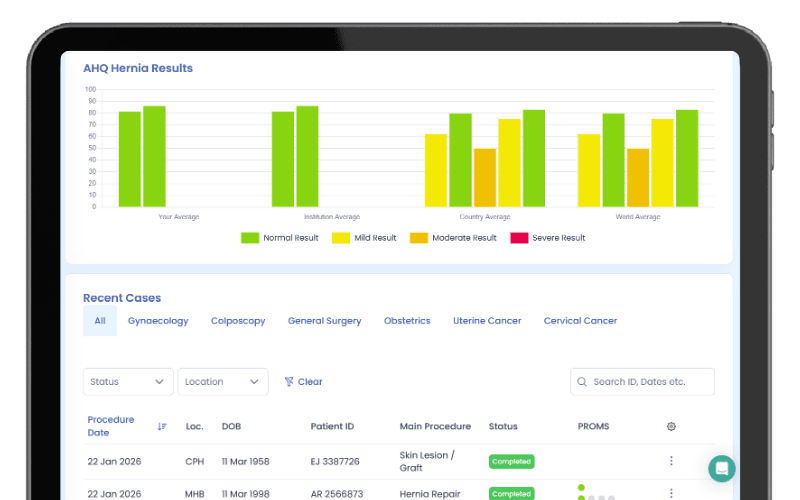
Surgical Performance Inshights and Progress Dashboard

Urology outcomes

Urology outcomes

frequently asked questions

What is a general surgery self audit?

A general surgery self audit is a systematic review of your own cases and outcomes against a standard or against your peers. In SurgicalPerformance it happens continuously, because every case you enter builds the record rather than requiring a separate data-collection exercise.

How do I track surgical site infections that present after discharge?

Patient-reported surveys are sent automatically after the patient leaves your care, so recovery problems that would otherwise present to a GP or emergency department become visible to you.

Can I track hernia recurrence and chronic pain?

Yes. The Abdominal Hernia Questionnaire follows hernia patients from a pre-operative baseline out to 18 months, which covers the period where recurrence and chronic pain typically appear.

Can I use this for my RACS surgical audit?

SurgicalPerformance produces a continuous, benchmarked record of your own cases and outcomes, which is the kind of evidence a total practice audit calls for. Check the current requirements with your college for how to record it, or explore our modules as a Certified Learning Provider with AMA CPD Home.

Who can see my data?

Only you. Your records are not shared with your hospital, your college or your insurer, and they do not appear in any public rating. Only de-identified, aggregated data powers peer benchmarks.

Can I compare my outcomes with other general surgeons?

Yes. As our suite of de-identified data within the general surgery specialty grows you can benchmark your results against the aggregated data from other surgeons, while your own data stays confidential to you.

START TRIAL

Start building your general surgery outcomes record from your first case

Start building your general surgery outcomes record from your first case

  • No credit card required

  • 10 cases of full functionality

  • Full access to INSIGHTS and PROMS

  • Discounted annual subscription rates

SurgicalPerformance is a confidential online platform, built for surgeons by surgeons, to help you ‘know better’.

SurgicalPerformance is a confidential online platform, built for surgeons by surgeons, to help you ‘know better’.

SurgicalPerformance is a confidential online platform, built for surgeons by surgeons, to help you ‘know better’.